

Sales Development

Lauren Daniels
September 16, 2026

Most leaders start with the same number when they budget for an SDR: base salary. You see a role advertised at $60,000, add another $20,000 or so for commission, and arrive at roughly $80,000. At that point, the hire can look fairly straightforward.
Then the real costs start showing up.
Once you account for everything that comes with hiring and keeping an SDR in-house, the year-one cost is much closer to $125,000 to $165,000 for a single rep. That $60,000 base salary you started with represents only about 38% of what you are actually spending.

The remaining 62% comes from costs that are easy to overlook when you are building the initial budget. These include employer burden, recruiting, ramp time, sales tools, management overhead, and attrition costs.
Those costs matter because your SDR doesn't start producing pipeline at full capacity on day one.
If you are deciding whether to build an SDR function in-house or outsource it, the number that matters is the fully loaded year-one cost. That is where the economics of the decision become much clearer.
The most common mistake is comparing an SDR's base salary to a vendor's monthly retainer. On paper, that can make an in-house hire look significantly cheaper. In reality, you are leaving a large part of the equation off the spreadsheet.
The real cost starts accumulating before the SDR generates meaningful pipeline. You have recruiting costs before they join, employer costs once they are hired, software and tooling once they are onboarded, and management time throughout the process.
Then there is ramp time, when you are paying the full cost of the rep while they are still learning the role and building toward productivity.
Attrition also adds. If the rep leaves, you are back in the hiring process and absorbing many of those costs again. Put all of that together, and a fully loaded in-house SDR costs roughly $125,000 to $165,000 in year one.
That is the number worth putting next to an outsourcing option when making the decision. A $60,000 salary on a job posting tells you very little about what that SDR will actually cost your business.
Start with the obvious costs. The ones that show up in the offer letter and the comp plan.
Base salary. SDR base salaries in the US market range from $55,000 to $70,000 depending on experience and location. Call it $62,000 for a mid-market hire.
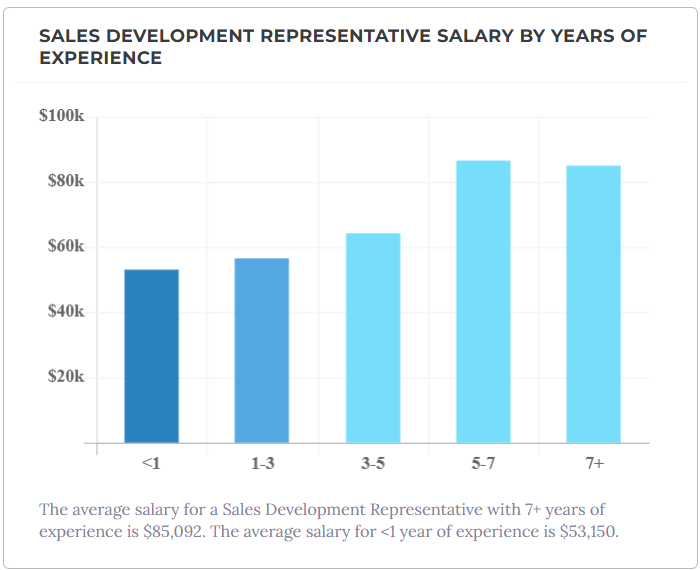
Variable compensation. On-target earnings typically add 30% to 50% of base. At a $25,000 variable, total cash compensation reaches roughly $87,000.
Payroll taxes and benefits. Employer-side taxes, healthcare, and retirement contributions typically add 20% to 30% on top of cash compensation. That is another $17,500 to $22,000.
So far, you are at around $109,000, and you have only paid the person. The expensive part has not started.
Tooling and tech stack
A modern SDR cannot work with a phone and a notebook. They need a CRM seat, a sales engagement platform, a dialer, a data and enrichment provider, an email validation tool, and usually an intent or signal layer.
Per rep, this stack runs $500 to $2,000 per month. That is $6,000 to $12,000 per year, per SDR, before any enterprise contract minimums.
Management overhead
Someone has to hire, onboard, coach, and run call reviews for this rep. Effective SDR management requires 6-8 hours of real coaching time per SDR per month. A sales manager overseeing SDRs distributes roughly $10,000 to $20,000 of management cost per rep per year.
If the founder or VP of Sales is doing this themselves, that time carries a real opportunity cost. Most companies run SDR management on too thin a ratio. The ideal is 1 manager per 10 SDRs. Below that, management falls on sales leaders who already have a full plate, and SDR quality drifts as a result.
Recruiting and onboarding
Filling the seat is not free. An agency placement runs 15% to 20% of first-year salary. Even with in-house recruiting, sourcing, screening, and interviewing consume real hours. Budget $8,000 to $15,000 per hire in recruiting costs alone, and more if the first hire does not work out.
Onboarding (software access, training materials, manager time) adds another $2,000 to $5,000 per hire on top of that.
Ramp time
This is the cost that most budgets undercount. A new SDR is not productive on day one. The first two weeks are spent onboarding, with no output. The next four to six weeks are ramp time. Output is still below target. Full productivity typically comes in months four to six, even in a best-case scenario with strong enablement.
During that ramp window, you are paying full salary and employer burden while receiving partial or no pipeline output. Modelled conservatively, that productivity loss costs $15,000 to $20,000 in year one before the rep books their first consistent meetings.
The base salary you started with, $62,000, accounts for roughly 38% of the real cost. The other 62% is invisible until someone adds it all up.

The breakdown above assumes the seat is filled and the rep stays. SDRs have one of the highest turnover rates in all of sales. Average SDR tenure is 14 months. Annual attrition rates across in-house SDR teams run 30% to 39%. For a team of four SDRs, that means losing one to two reps every year.
When a rep leaves, you do not just restart recruiting. You sit with an empty seat producing zero pipeline while you source, hire, and ramp a replacement. That cycle easily runs four to six months. Each attrition event adds $8,000 to $20,000 in transition cost on top of all the standard overhead like the recruiting fees, the productivity gap during the vacancy, and ramp time for the replacement.
Over three years, attrition can become the highest cost in an in-house SDR program. It does not show up as a bill. It shows up as missed pipeline and stalled revenue. That makes it easy to ignore until the damage is done.
In-house SDR ramp time runs 60 to 90 days from start date to consistent qualified meeting flow. Outsourced SDR programmes typically go live within two to four weeks.
That 30 to 45 day gap matters more than most leaders realise. A qualified meeting can create a meaningful pipeline opportunity. At full ramp, your team may book eight meetings per month. Each extra month of delay costs real pipeline value. It also delays revenue.
The in-house cost model hides this delay.
Outsourced programmes absorb the ramp because the people are already trained. The vendor's ICP workshop and account preparation happen in weeks one and two. Calibration happens in weeks three and four. Most engagements are producing meetings by week five.
Outsourced SDR programmes for mid-market B2B engagements typically run $36,000 to $96,000 per year depending on scope, seniority, and what is included in the retainer.
Well-structured programmes include the SDR time, training, tool stack, data, ICP and messaging development, reporting, and management. The retainer is the total cost. There are no separate tool licences, no recruiting fees, no employer burden, and no attrition risk.
Outsourced is 50% to 65% lower in total cost than in-house for year one. That gap narrows in years two and three as in-house tenure improves productivity. But year one is where most outsourced engagements pay for themselves. It is also where in-house builds accumulate costs. Many of these costs were never in the original budget.
The practical comparison:
The cost case for outsourcing is clear in year one. But in-house has genuine advantages in the right context.
Deep product specialisation. If the SDR needs extensive technical training, in-house may have an advantage. This is common in highly regulated industries. It also applies to complex APIs and deep vertical specialisation. A long-tenured in-house SDR builds deeper product knowledge. An outsourced programme can take longer to replicate that depth.
Strong sales leadership with bandwidth. In-house SDR quality holds when a VP of Sales has prior SDR management experience and genuine weekly coaching time. Be honest about whether that is actually the case for your team.
Long-term talent development. If the strategy includes growing SDRs into account executives and AEs into managers, in-house builds the talent pipeline that outsourced does not. The cost premium is partially offset through the long-term value of promoted closers.
The maths improves for in-house teams in years two and three. Tenure builds value. An SDR with 18 to 24 months in the role brings institutional knowledge. They also bring deeper product knowledge and relationship context.
An outsourced provider may find this harder to replicate. If you can retain talent, in-house costs per meeting can improve significantly over time.
A third path is worth considering. Many mid-market B2B teams run a hybrid: outsourced SDRs handle top-of-funnel cold outreach, in-house SDRs handle inbound qualification and account-based motion on existing pipeline.
This split works because the two motions require different skills.
Cold outbound benefits from vendor methodology, trained volume calling, and high-scale outreach discipline. Inbound and account-based motion benefit from product depth, internal context, and the ability to coordinate with marketing and customer success in real time.
The cost case for hybrid is also strong. Outsourcing top-of-funnel at $36,000 to $60,000 per year frees in-house SDR budget to hire one or two more senior people who can run the more sophisticated motion that vendors find harder to replicate. Same total spend. Better total output.
Whenever you evaluate an SDR hire, an outsourced partner, or a build-versus-buy decision, start with the fully loaded cost.
A $7,000-a-month outsourced engagement can look expensive next to a "$62,000 SDR." The picture changes when you compare it with a $150,000 fully loaded sales rep, especially when you factor in turnover risk and a four-month ramp period.
The companies that scale outbound efficiently understand what they are actually spending. They also know when to make that investment. They commit once they have enough evidence that the motion works.
Whistle works with B2B companies at different stages of that decision. Some bring us in as their outsourced SDR function while they validate their outbound motion. Others use us for pipeline generation and cold outreach before making an in-house hire.
That gives them a clearer picture of what works before they commit to building the team themselves. The decision should start with the full cost of the motion and what it takes to make it work.
If you want to run the numbers against your specific situation, it is worth having a conversation with the team.
What is the true fully loaded cost of an in-house SDR in 2026?
A fully loaded in-house SDR costs $125,000 to $165,000 in year one. Base salary accounts for roughly 38% of that total. The remaining 62% covers employer burden, recruiting and onboarding, ramp period productivity loss, tooling, management overhead, and attrition provision.
Why is SDR ramp time such a high cost?
An in-house SDR typically needs 60 to 90 days from their start date before they are producing consistent, qualified meetings. During that period, you are paying full salary and benefits for partial or zero pipeline output. Modelled as lost productivity value, a four-month ramp costs roughly $15,000 to $20,000 before the rep reaches full capacity.
What is SDR attrition and why does it matter for cost modelling?
SDR attrition refers to how frequently reps leave the role. Average SDR tenure is 14 months, and annual attrition across in-house teams runs 30% to 39%. Each attrition event triggers a full recruiting and ramp cycle, adding $8,000 to $20,000 in transition costs and creating a pipeline gap of several months before a replacement reaches productivity.
Is an outsourced SDR genuinely cheaper than in-house?
In year one, yes, by 50% to 65% on a total cost of ownership basis. The gap narrows in years two and three as in-house tenure improves productivity. For companies that need pipeline quickly, cannot absorb the ramp cost, or operate in high-attrition environments, outsourced is structurally more cost-efficient.
When does in-house SDR make more sense than outsourced?
In-house makes more sense when the product requires deep technical knowledge to sell effectively, when the sales leadership team has the bandwidth and experience to coach SDRs consistently, or when the business strategy includes building an internal talent pipeline from SDR through to account executive. In years two and three with strong SDR retention, the per-meeting cost of in-house also improves meaningfully.
What does a hybrid SDR model look like?
A hybrid pairs outsourced SDRs for top-of-funnel cold outreach with in-house SDRs for inbound qualification and account-based motion. The outsourced function handles volume, methodology, and cold prospecting discipline. The in-house function handles product depth, internal coordination, and relationship continuity. Many mid-market B2B teams find this split produces better total output than either model alone at a comparable total cost.